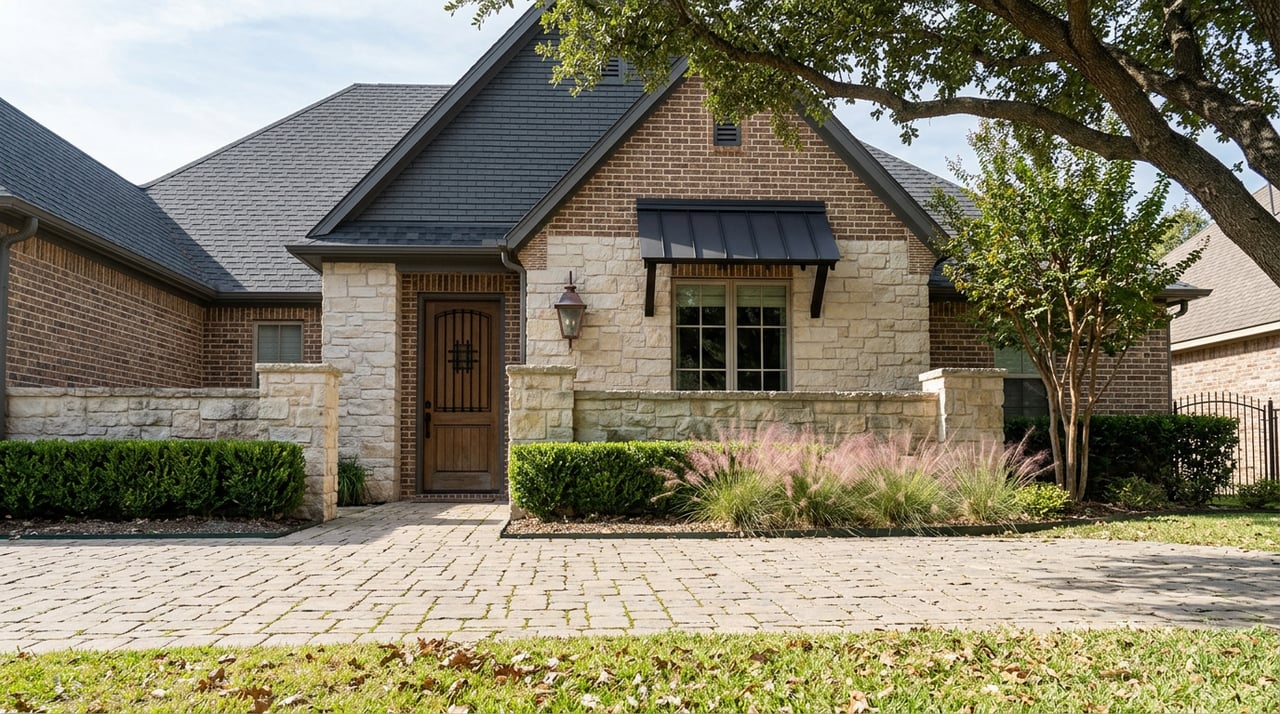
A listing agent recently described a homesite in Wyndemere this way: nearly three-quarter acre, backing to a shared pond with a lighted fountain, shaded through the afternoon and evening by existing tree cover, surrounded by custom homes in an established Heath community. Read that description twice and you will notice what it is actually selling. Not a house. Not yet. A place to put one, inside a neighborhood that has already done the work of growing up around it.
That distinction matters more in Heath right now than the number printed next to "lot size" on any listing sheet. Buyers comparing an established resale in Heath Crossing against a buildable homesite in one of Heath's newer one-acre enclaves tend to run the comparison on acreage alone. A full acre reads as more house, more privacy, more future equity than a third of an acre ever could. But acreage measures dirt. It says nothing about what is or is not growing on top of it, and in Heath, that gap is where the real price of a lot actually lives.
What Two Decades Bought in Heath Crossing
Heath Crossing began taking shape in 2006. Two decades later, the neighborhood carries 301 total lots, and by the most recent count only 28 remain without a home built on them. That is a built-out community in the practical sense: nearly nine in ten homesites have had two decades or close to it for trees to root, canopies to close overhead, and the raw grading of a new subdivision to soften into something that reads as established rather than assembled.
The individual lots run smaller than the acre-plus parcels drawing attention elsewhere in Heath, typically between .27 and .31 acres. What they carry instead of extra acreage is topography that took time to reveal itself: creek lots, lots backing to ponds, a tree-lined entry boulevard, and rolling terrain that a flat, freshly cleared acre simply cannot fake. The homeowners association runs a modest annual fee, in the range of $900 a year, which is worth noting mainly because it is proof the neighborhood has been stable enough, long enough, that its governance costs have settled into routine rather than the ramp-up pricing new developments often carry in their first years. The community sits close enough to Lake Ray Hubbard for boating access, near Buffalo Creek Golf Club, and within about a mile and a half of Amy Parks-Heath Elementary, inside Rockwall ISD.
None of that is unusual for Heath. What is worth pausing on is what a buyer gets the day they close: a lot where the maturity already happened. No waiting through several growing seasons for privacy screening to fill in. No newly poured driveway sitting in a field of raw sod. The house and the ground around it aged together, and a buyer steps into the result rather than the process.
The Other Side of the Ledger
Now look at what is actually for sale in Heath's newer one-acre communities, because it is rarely a finished product. In Terrabella, a lakefront enclave of only ten estates, the listing currently on the market is described as the last available homesite in the community. Its neighbors are not new. A recent sale at 2 Terrabella Ln, a 6,444-square-foot estate on just over an acre, built in 2008, backs that up: the listing leans hard on majestic oak and pecan trees that have had roughly eighteen years to reach that description. But the last open parcel in that same community has none of that yet. Whoever builds there is buying into a neighborhood with two decades of growth around it while starting their own yard from bare ground.
Wyndemere's build-ready homesite works the same way. The marketing calls out the pond, the fountain, the surrounding custom homes in an established setting, precisely because those are the neighborhood's selling points, not the lot's. Le Ruisseau, in the heart of Heath, is currently marketing its remaining parcels, some over 1.8 acres, as opportunities for custom or spec estate homes. Again: raw acreage, sold on the promise of the address around it rather than anything already growing on the parcel itself.
Villas of Heath sits somewhere between the two extremes. It is a small, ten-home enclave where properties rarely come up for sale, and at least one home there dates to 2015, on a fully fenced one-acre lot. Call it roughly a decade of growth, more established than a brand-new build site, less settled than a two-decade Heath Crossing lot.
Here is the comparison laid out plainly:
| Community | Land Status Today | Approximate Vintage | What a Buyer Actually Gets |
|---|---|---|---|
| Heath Crossing | Built out, resale market | Since 2006 | A grown lot and house, matured together |
| Villas of Heath | Small built enclave, rare turnover | Homes from at least 2015 | Roughly a decade of tree and yard growth |
| Terrabella (last homesite) | One remaining vacant parcel | Community since 2008, lot itself unbuilt | A mature neighborhood, a bare yard |
| Wyndemere (build site) | Vacant homesite in an established area | Neighborhood mature, lot unbuilt | Same trade: grown neighbors, blank ground |
| Le Ruisseau (remaining lots) | Raw acreage, multiple lots available | Unbuilt | Full acreage with no existing growth |
A lot's age is not the same number as its house's age. Some of Heath's biggest homesites are also its newest yards.
The Trade Buyers Are Actually Making
None of this makes the acre lots a worse purchase. A buyer who wants a specific floor plan, a specific builder, or full control over how the ground is used has good reason to choose Le Ruisseau or the last parcel in Terrabella over anything already built in Heath Crossing. But that buyer should go in knowing what they are trading for that control. Trees take years to reach the kind of canopy that shows up in a listing photo for a 2008-built Terrabella estate. Privacy screening along a fence line does not arrive with the sod. The rolling, established feel that makes Heath Crossing photograph the way it does was not landscaped in during a single build season. It accumulated.
That is the actual cost of the raw acre, and it rarely shows up on a settlement statement. It shows up as the first several years of ownership, spent watching a yard catch up to a neighborhood that was already there.
For a buyer weighing both, the useful question is not "how many acres" but "how old is what's on it." A quarter-acre creek lot in Heath Crossing with twenty years of growth can deliver more usable privacy today than a fresh acre that will not feel finished for a decade. An acre in Le Ruisseau or the last Terrabella parcel can deliver more long-term control, at the cost of patience most buyers underestimate when they are standing on cleared dirt imagining the finished yard.
FAQ
Is Heath Crossing still building new homes, or is it entirely resale now? With 28 of 301 total lots still without homes, there is limited new construction available, but the overwhelming majority of activity in the neighborhood today is resale.
Does a bigger lot in a newer Heath community always mean more value than a smaller, established one? Not automatically. Raw acreage and grown acreage are different products even when the square footage on the deed is identical. A buyer comparing the two should weigh tree maturity, existing privacy screening, and how long it will take a new lot to reach the condition an older one already has.
What should a buyer ask before choosing a buildable lot over an established resale in Heath? Ask what currently exists on the parcel beyond graded dirt, how old the surrounding homes in that same section are, and what a builder's timeline looks like for landscaping installation versus what is already standing on comparable resale lots nearby.
If you are weighing a Heath Crossing resale against a buildable lot elsewhere in Heath and want a side-by-side read on what each one actually gets you today versus what it will look like in ten years, The Agency Rockwall can walk both comparisons with you. Request a complimentary home valuation and we will help you price the trade, not just the lot.
This article is general information, not legal, tax or financial advice. Consult a qualified professional about your situation.